

On November 23, 2026, Ant Group’s AI health app Afu open-sourced LingSante, the medical and health AI model family that powers its service for 150 million users
- Ant Group open-sourced LingSante on November 23, 2026 — the AI model family behind its health app Afu, used by 150 million people with nearly 20 million consultations a day.
- Two models are free on Hugging Face now: a multimodal model that reads images, skin photos and lab reports, and a 560-billion-parameter reasoning model for complex cases.
- Open weights let clinics run medical AI on their own premises, keeping patient data in-house — on workstation-class hardware, not data centers.
- Safety boundaries are explicit: a research and enabling tool, not a medical device, not a replacement for clinical diagnosis.
Open-source health AI has mostly meant research models: impressive on benchmarks, unused by real patients. That changed on November 23, 2026, when Ant Group released the weights of LingSante — the AI family powering its health app Afu, one of the world’s most heavily used health services, with 150 million users and nearly 20 million consultations a day.
From China’s Biggest Health App to an Open Release
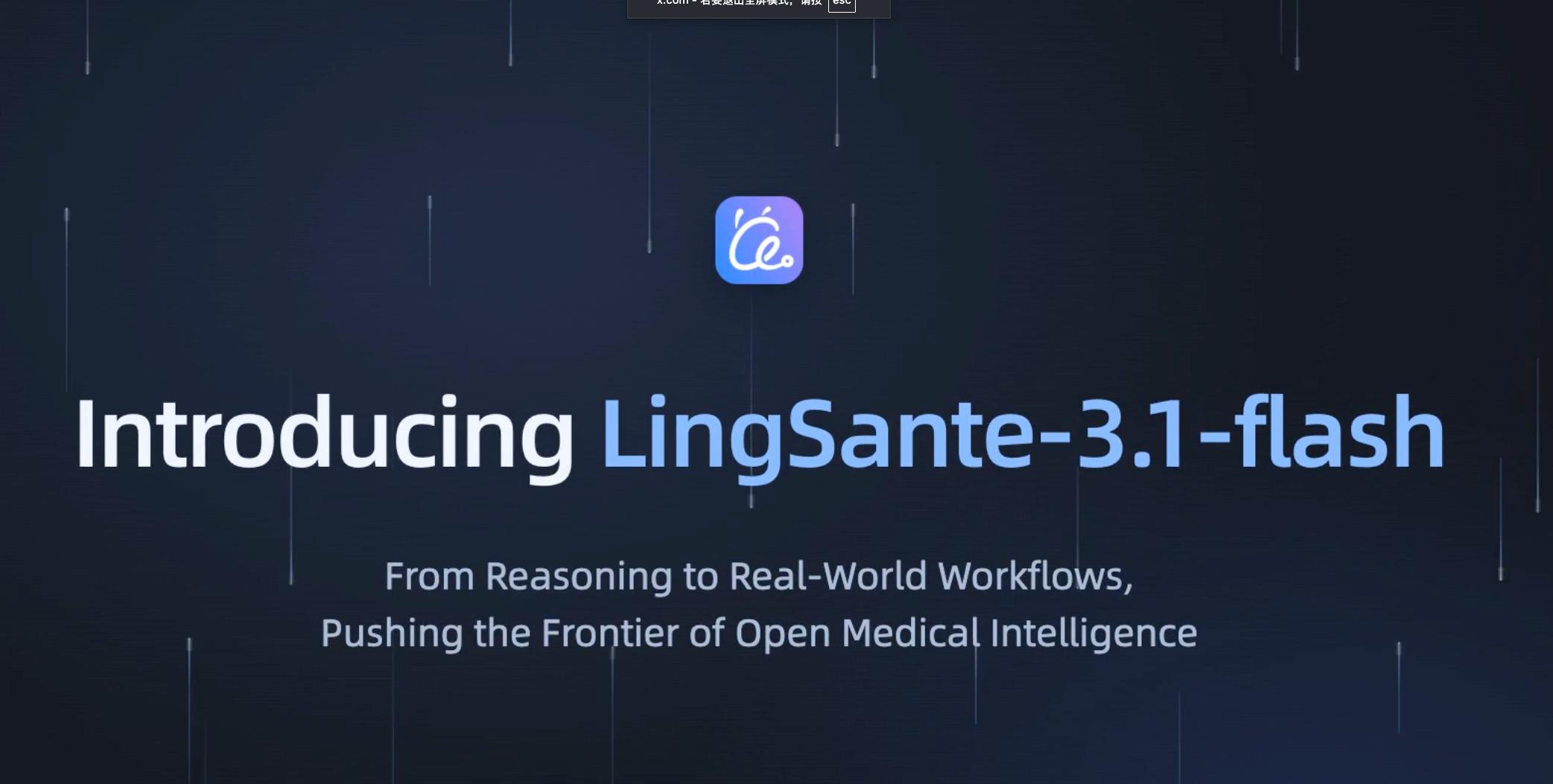
Asia Tech Times’ coverage of the release put the growth into perspective: Afu went from 100 million users in February 2026 to 150 million by November — 50 percent in eight months. Its models are now free to download on Hugging Face: LingSante-3.1-air-VL, a natively multimodal model (124 billion parameters, 5.5 billion active per token), and LingSante-3.1-flash, a 560-billion-parameter deep-reasoning model with a million-token context window. This is Ant Group’s first open-sourced natively multimodal health model family; its earlier open model was text-only and could not read X-rays, skin photos or lab reports.
“AI is becoming a bridge between clinical care in hospitals and health management beyond hospital settings, accelerating a fundamental shift from treating illness to maintaining health,” said Cyril Han, CEO of Ant Group.
What the Models Can Do
The lighter model handles the everyday stuff: medical image understanding, skin-condition analysis (more than 120 conditions), diet and nutrition assessment, and medical report interpretation. The heavier model is built for complex clinical tasks — evidence-based retrieval, long medical workflows, complex case analysis. Specialized family members include LingSante-Pulse, which predicts risk for more than 150 conditions, and LingSante-MedGuard, a dedicated safety model covering medical safety, compliance and bioethics. LingSante-Live powers real-time AI video consultations already live in the Afu app, where users can also bring an online doctor into the call, with review coverage across 16 specialties.

The Small-Clinic Math
Here is the part practitioners will notice: at 5.5 billion active parameters per token, the lighter model runs on workstation-class hardware such as NVIDIA RTX Spark-class devices. A small clinic or a medical research team can put specialist-grade medical AI on their own machines — no cloud contract, and patient data stays inside the institution. For solo practices and community clinics that have watched enterprise AI pass them by, that is the difference between reading about medical AI and actually running it.
Safety First
The positioning is deliberately conservative: LingSante is a research and enabling tool — not a medical device, and not a replacement for clinical diagnosis. The imaging-report capability is explicitly research-only. MedGuard ships alongside the main models to flag medical-safety, compliance and bioethics risks, and local deployment lets institutions operate within their own regulatory boundaries. Ant Group’s stated principle is that AI assists doctors rather than replacing them.
The Bigger Picture
Between video consultations, a health manager that builds personalized plans, and now open weights that anyone can inspect, the release marks a shift: health AI is moving from something you are given to something you can actually look inside.